ITIL has evolved for a world of integrated digital products and services, AI-enabled work and rising expectations. For organisations in Aotearoa New Zealand, the real question is not how much of the framework to implement, but how to use it proportionately and well.
A new version, but a familiar challenge
A new version of ITIL usually produces two reactions. Some practitioners are keen to explore the new thinking. Others wonder how much terminology, training and organisational change is about to arrive in the name of progress.
Both reactions are understandable. The more useful question is whether ITIL (Version 5) helps organisations deal with the way digital products and services are now designed, delivered and improved.
That matters in New Zealand. Our organisations are often smaller than their global counterparts, service management teams may be lean, and important parts of a service may be delivered by cloud providers, software vendors, managed service providers and specialist partners. Any adoption of ITIL 5 therefore needs to be practical, selective and proportionate.
Evolution, not a reset
ITIL 5 builds on ITIL 4 rather than replacing it. The guiding principles, the ITIL Value System, governance, practices and continual improvement remain recognisable. Existing knowledge has not suddenly expired, and organisations that have adopted ITIL 4 sensibly should not need to redesign everything.
The change is mainly in emphasis. ITIL 5 responds to organisations that are increasingly digital-first, product-centric and AI-enabled, while recognising that customers experience products and services together rather than as separate management disciplines.
The main changes at a glance
The most visible change is the Product and Service Lifecycle Model. It connects eight activities: Discover, Design, Acquire, Build, Transition, Operate, Deliver and Support. The intention is to give product and service professionals a shared view of the work, rather than allowing responsibility to disappear between development, transition, operations and support.
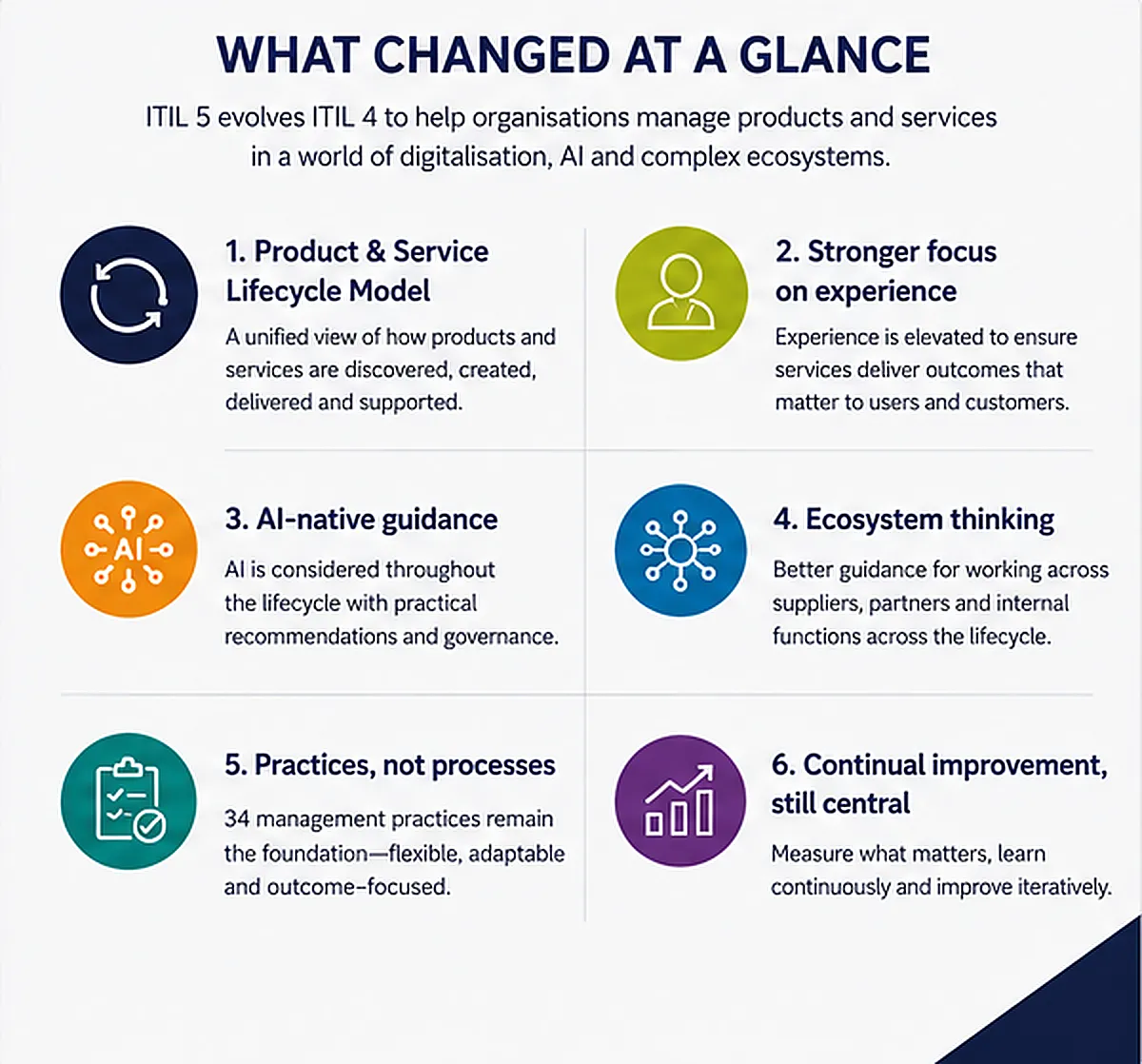
ITIL 5 also places greater emphasis on digital experience. Traditional measures such as availability, response time and resolution time remain useful, but they do not prove that a service is usable, trusted or effective. The experience of customers, users and employees is treated as part of value, not decorative feedback collected after the real decisions have been made.
Artificial intelligence is embedded throughout the framework. “AI-native” does not mean every activity should be automated. It means organisations should consider how AI can enable work, while also governing its data, risks, decisions and outcomes responsibly.
The 34 management practices remain, but are reorganised into product and service management practices and general management practices. The qualification scheme is also streamlined around three advanced streams: ITIL Practice Manager, ITIL Managing Professional and ITIL Strategic Leader, with all three contributing towards ITIL Master.
What does this mean for New Zealand?
The value of ITIL 5 will not come from reproducing the operating model of a large multinational organisation. A smaller organisation should not need a dedicated owner, committee and document set for every part of the framework. That path leads reliably to more administration, which is rarely the service outcome anybody requested.
The opportunity is to use the new lifecycle to clarify where work happens, how information moves and who remains accountable. This is particularly important in supplier-heavy environments. An organisation may design a service internally, buy a platform from one vendor, use another partner to implement it and rely on a managed service provider to operate it. To the customer, it is still one service.
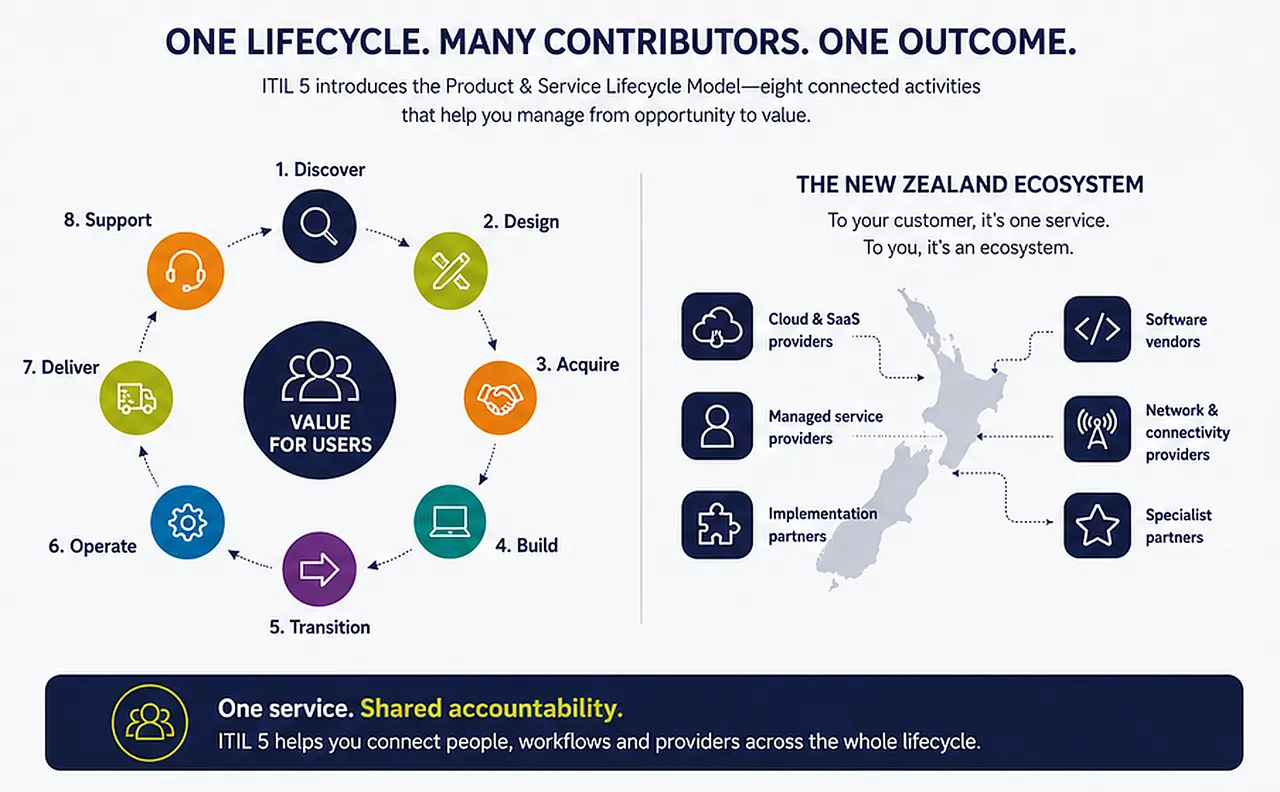
Outsourcing delivery does not outsource accountability for value. ITIL 5 should help organisations connect the contributors, identify gaps between them and focus scarce capability on the outcomes that matter most.
Use the guidance intelligently
ITIL 5 is not a reason to rename every process or launch a framework implementation programme before identifying a problem worth solving. It is an opportunity to review whether product and service teams are connected, whether suppliers operate as an ecosystem, whether measures reflect real experience and whether AI is being adopted with sufficient control.
The framework should be judged by what it helps an organisation improve, not by how accurately the organisation reproduces it. The challenge is not to implement more ITIL. It is to use ITIL more intelligently.
Coming next in this five-part series
- Part 1: ITIL 5 - what has changed and why it matters
- Part 2: The Product and Service Lifecycle Model
- Part 3: Practice Manager, Managing Professional and Strategic Leader
- Part 4: The management practices - what has changed in practice
- Part 5: Applying ITIL 5 in New Zealand - proportionality, suppliers and where to begin
Sources
- ITIL Foundation (Version 5): What’s new?
- New ITIL explained for certified professionals
- The new ITIL product and service lifecycle model
ITIL® is a registered trademark of the PeopleCert group.